
Cyprus Tax in 2026: A Simple Guide
The main Cyprus tax rules after the 2026 reform for companies and individuals, including tax residence, non-dom, crypto, pensions, VAT and property taxes.
(A) At a glance
- Cyprus reformed its tax system from 1 January 2026, raising corporate tax to 15% while cutting the tax on dividends, widening the tax-free band for individuals, introducing a flat 8% tax on crypto gains and abolishing stamp duty, and the main rates now stand as follows.
| Tax | 2026 position |
|---|---|
| Corporate income tax | 15% |
| IP Box (profit from qualifying IP) | As low as 3% effective |
| Personal income tax | 0% up to €22,000, rising in bands to 35% above €72,000 |
| Dividends received by Cyprus-domiciled individuals | 5% defence contribution on profits from 2026 |
| Dividends and interest received by non-domiciled individuals | Exempt |
| Interest received by Cyprus-domiciled individuals | 17% defence contribution |
| Capital gains | 20%, only on Cyprus property and on shares in companies at least 20% of whose value comes from it |
| Crypto gains of individuals | 8% |
| VAT | 19% standard rate |
| Inheritance, gift and wealth tax | None |
| Stamp duty | Abolished from 1 January 2026 |
| Withholding tax on outgoing dividends, interest and royalties | Generally none |
(B) Companies
- A Cyprus tax-resident company pays 15% on its worldwide taxable profit under the Income Tax Law 118(I)/2002, as amended by Law 244(I)/2025 (the "Income Tax Law"), with several exemptions that keep Cyprus attractive for holding and IP structures.
Tax residence
- A company is resident if it is managed and controlled in Cyprus or incorporated here, unless a tax treaty provides otherwise.
- Where a treaty applies, residence usually turns on where the company is actually managed, so management and control in Cyprus remains the test that matters in practice.
Dividends received
- Dividends a company receives are exempt from corporate tax and, in most cases, from the special defence contribution.
- The exceptions are:
(a) a 5% defence contribution on foreign dividends from a mainly passive company taxed at an effective rate below 7.5%; and
(b) a transitional 17% on dividends received in 2026 or 2027 out of a Cyprus company's 2024 or 2025 profits, unless the recipient is ultimately owned by non-residents or non-doms.
Interest and rent
- Interest and rent are taxed as ordinary profit at 15%, with no defence contribution for the company.
Notional interest deduction
- New equity used in the business attracts a deduction based on the 10-year government bond yield plus 5%, capped at 80% of the taxable profit it generates.
Losses
- Tax losses can be carried forward for 7 years, up from 5.
Payment and filing
- Provisional tax is paid in 2 instalments by 31 July and 31 December, and from the 2026 tax year the return and any balance are due by 31 January of the second year after the year end.
(C) The IP Box

How it works
- Under the Income Tax Law and the Income Tax (Intangible Assets) Regulations, ΚΔΠ 336/2016, a company deducts 80% of the qualifying profit it earns from a qualifying intangible asset, so only 20% of that profit is taxed at 15%, an effective rate of no more than 3%.
- The regime follows the OECD "modified nexus" approach, so the size of the deduction depends on how much of the research and development behind the asset the company carried out itself or paid unrelated parties to carry out.
Who can use it
- The IP Box is available to Cyprus tax-resident companies and to Cyprus branches of foreign companies, and the research and development does not have to take place in Cyprus.
Which assets qualify
- A qualifying asset must be the result of research and development and be legally protected, and the main categories are:
(a) patents and utility models, including extensions of patent protection;
(b) copyrighted computer software;
(c) plant variety rights and orphan drug designations; and
(d) for smaller businesses, whose annual income from IP is no more than €7.5 million and whose group's total revenue is no more than €50 million, other IP that is certified as non-obvious, useful and novel. 15. Trademarks, brand and business names, image rights and other marketing-related IP do not qualify, although they can still benefit from capital allowances and the notional interest deduction.
What income qualifies
- Qualifying income is the income the company earns from the asset, including:
(a) royalties and licence fees;
(b) the part of the price of a product or service that comes from the asset ("embedded income"); and
(c) compensation and insurance proceeds connected with the asset. 17. A gain of a capital nature on selling a qualifying asset is not subject to corporate tax at all.
Calculating the qualifying profit
- The qualifying profit is the profit from the asset, meaning its income less the direct costs of earning it, multiplied by the nexus fraction.

| Term | What it means |
|---|---|
| QE (qualifying expenditure) | Research and development carried out by the company itself, including R&D salaries and direct costs, and R&D outsourced to unrelated parties |
| UE (uplift) | The lower of 30% of QE and the cost of acquiring the asset plus R&D outsourced to related parties |
| OE (overall expenditure) | QE plus the cost of acquiring the asset and R&D outsourced to related parties |
- Expenditure is counted over the whole life of the asset, not only in the current year, so the fraction reflects all the research and development that went into it.
- Where the company did all the research and development itself or through unrelated parties, the fraction is 100% and the full 80% deduction applies, while buying the IP or having a group company do the research reduces it.
Example 1: software developed in-house
- A Cyprus company develops software with its own team and licenses it, earning €1,000,000 in royalties with €200,000 of direct costs, and because all the research and development is its own the nexus fraction is 100%.
| Without the IP Box | With the IP Box | |
|---|---|---|
| Royalty income | €1,000,000 | €1,000,000 |
| Direct costs | (€200,000) | (€200,000) |
| Profit from the asset | €800,000 | €800,000 |
| IP Box deduction (80%) | – | (€640,000) |
| Taxable profit | €800,000 | €160,000 |
| Corporate tax at 15% | €120,000 | €24,000 |
| Effective rate | 15% | 3% |

Example 2: part of the research done by a group company
- Over the life of a patent, a company has spent €300,000 on its own research team, €100,000 on research by an unrelated university and €200,000 on research by a group company, and it makes a profit of €1,000,000 a year from the patent.
| Step | Calculation | Amount |
|---|---|---|
| QE | €300,000 own team + €100,000 university | €400,000 |
| UE | Lower of 30% of QE (€120,000) and the group-company research (€200,000) | €120,000 |
| OE | €400,000 QE + €200,000 group-company research | €600,000 |
| Nexus fraction | (€400,000 + €120,000) ÷ €600,000 | 86.67% |
| Qualifying profit | €1,000,000 × 86.67% | €866,667 |
| IP Box deduction | 80% × €866,667 | €693,333 |
| Taxable profit | €1,000,000 − €693,333 | €306,667 |
| Corporate tax at 15% | €306,667 × 15% | €46,000 |
| Effective rate | €46,000 ÷ €1,000,000 | 4.6% |
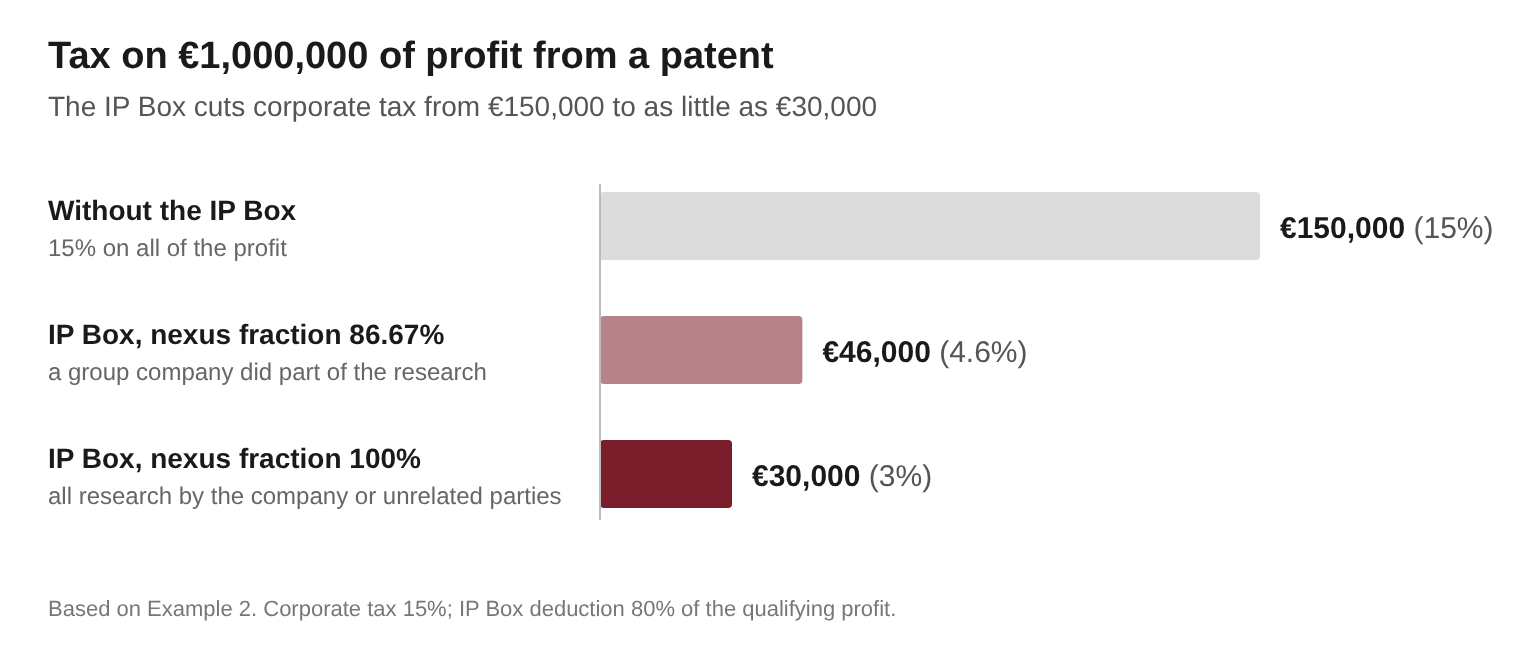
- Had the company carried out that research itself or given it to an unrelated party, the fraction would have been 100% and the tax €30,000, as the chart below shows.
Losses and other rules
- Where the calculation produces a loss, only 20% of it can be carried forward or set against the profits of group companies.
- The cost of acquiring or developing an intangible asset is deducted over its useful life, up to a maximum of 20 years.
- A company may choose to claim less than the full deduction in any year.
- Spending on research and development of intangible assets also attracts a 120% deduction, which the 2026 reform extended until 2030.
- Groups with consolidated annual revenue of €750 million or more fall under the 15% global minimum tax, which Cyprus enacted in December 2024, so for them a top-up tax can reduce the IP Box saving.
(D) Individuals
- An individual who is tax resident in Cyprus pays income tax on worldwide income, while a non-resident pays only on income arising in Cyprus, so residence is the first question for anyone moving here.
Becoming tax resident
- An individual becomes tax resident under either of 2 tests:
(a) the 183-day rule, by spending more than 183 days in Cyprus in the calendar year; or
(b) the 60-day rule, by spending at least 60 days in Cyprus, no more than 183 days in any other single country, working, running a business or holding a directorship in Cyprus, and keeping a permanent home here, owned or rented.
Income tax bands
- Income tax on an individual's taxable income is charged at the following rates.
| Taxable income | Rate |
|---|---|
| Up to €22,000 | 0% |
| €22,001 – €32,000 | 20% |
| €32,001 – €42,000 | 25% |
| €42,001 – €72,000 | 30% |
| Over €72,000 | 35% |
Non-domiciled residents
- A resident who is not domiciled in Cyprus pays no defence contribution on dividends or interest for up to 17 of any 20 years, and from 2026 a long-term resident who has passed that point can keep the benefit by paying €250,000 for each 5-year period, for up to 2 periods.
Exemptions for people taking up employment here
- 20% of employment income, up to €8,550 a year, is exempt for 7 years for a first employment in Cyprus by someone who was not resident here for the previous 3 years and was employed abroad by a non-Cyprus employer.
- 50% of employment income is exempt for 17 years where pay exceeds €55,000 a year and the person was not resident in Cyprus for the previous 15 years.
Pensions and pension schemes
- A Cyprus resident receiving a pension for work done abroad can elect each year to pay a flat 5% on the amount above €5,000, raised from €3,420 in 2026, instead of the normal income tax bands.
- Lump sums paid on retirement from an approved pension or provident fund in Cyprus or the EU, including from commuting a pension, are fully exempt from income tax.
- Contributions to approved pension and provident funds are deductible up to 10% of remuneration, within an overall cap of 1/5 of chargeable income shared with social insurance, life insurance, medical fund and GHS contributions.
- From 2026, the part of an ex gratia retirement or termination payment above €200,000 that is not provided for in the employment terms is taxed at a flat 20%.
Deductions and filing
- From 2026 there are new deductions for children, for rent or mortgage interest on the main home and for green investments, subject to family income limits.
- Employees file their 2026 tax return by 31 July 2027.
(E) Dividends, interest and capital gains
- Dividends and interest are not subject to income tax for individuals but to the special defence contribution, which depends on domicile, while capital gains tax applies only to Cyprus property.
- The Capital Gains Tax Law, as amended by Law 242(I)/2025, now allows lifetime exemptions of €150,000 on the sale of a main residence, €50,000 on farmland sold by a farmer and €30,000 on other disposals, within an overall cap of €150,000.
| Income or gain | Domiciled resident | Non-domiciled resident |
|---|---|---|
| Dividends | 5% on profits from 2026; 17% on earlier profits paid out by 31 December 2031 | Exempt |
| Interest | 17% (3% on certain government and listed bonds) | Exempt |
| Rent | Income tax only; defence contribution on rent abolished | Income tax only |
| Gains on shares and other securities | Exempt, unless the company's value comes at least 20% from Cyprus property | Same |
| Gains on Cyprus property | 20% capital gains tax | Same |
| Crypto gains | 8% | 8% |
(F) Crypto-assets

- From 1 January 2026, an individual's gains from disposing of crypto-assets are taxed at a flat 8% under the Income Tax Law, instead of the normal income tax bands.
- Crypto-assets acquired through mining fall outside the 8% regime, and losses on crypto-assets can only be set against crypto gains of the same year.
- The 8% rate is written for individuals, so companies holding or trading crypto-assets should take specific advice on how their gains are taxed.
(G) VAT, property taxes and what Cyprus does not tax
- Beyond income taxes, the costs most clients meet are VAT and Land Registry fees, and several taxes common elsewhere do not exist in Cyprus at all.
VAT
- VAT is charged at a standard rate of 19%, with reduced rates of 9%, 5% and 3%; a business must register once its taxable supplies exceed €15,600 in 12 months, and a reduced 5% rate can apply to a main residence if its conditions are met.
Land Registry transfer fees
- Transfer fees are 3% up to €85,000, 5% up to €170,000 and 8% above, halved where no VAT applies and not payable where VAT was charged.
Stamp duty
- Stamp duty was abolished from 1 January 2026 by Law 239(I)/2025, although documents signed by at least one party by 31 December 2025 remain under the old rules.
Taxes Cyprus does not have
- Cyprus has no inheritance, gift, wealth or immovable property tax, since estate duty was abolished in 2000 and immovable property tax in 2017.
Withholding tax
- There is generally no withholding tax on dividends, interest or royalties paid abroad, except payments to EU-blacklisted jurisdictions, dividends to related companies in low-tax jurisdictions (5% from 2026) and royalties for rights used in Cyprus.
Tax treaties
- Cyprus has more than 65 double tax treaties, which can reduce foreign tax on income flowing to and from Cyprus.
(H) What changed on 1 January 2026
- The reform package was enacted in December 2025 and took effect on 1 January 2026, so guides written before then are now out of date on most of these points.
| Area | Before | From 2026 |
|---|---|---|
| Corporate tax | 12.5% | 15% |
| Deemed dividend distribution | 17% on 70% of undistributed profits | Abolished for 2026 profits onward; 2024 and 2025 profits still caught unless paid out in time |
| Defence contribution on dividends (domiciled) | 17% | 5% |
| Defence contribution on rent | Payable | Abolished |
| Personal tax-free band | €19,500 | €22,000 |
| 60-day rule | Could not be resident elsewhere | That condition removed |
| Non-dom after 17 years | Benefit ended | €250,000 per 5-year period, up to 2 periods |
| Tax losses | 5 years | 7 years |
| Crypto gains | No specific rule | 8% |
| Capital gains exemption on main residence | €85,430 | €150,000 |
| Stamp duty | Payable on contracts | Abolished |
| Foreign pensions taxed at 5% | Above €3,420 | Above €5,000 |
| Ex gratia retirement or termination payments | No specific rule | 20% on the part above €200,000 |
(I) FAQs
How do I become tax resident in Cyprus?
You become resident either by spending more than 183 days in Cyprus in a calendar year or by meeting the 60-day rule, which also requires work, a business or a directorship in Cyprus and a permanent home here, and no more than 183 days in any other country.
Is tax residence the same as a residence permit?
Tax residence depends on the days you spend and your ties to Cyprus, whereas a residence permit is an immigration status, so one does not automatically give you the other.
Do I need to buy property to become tax resident?
A rented home is enough for the 60-day rule, provided it is a permanent home available to you throughout the year.
What does non-dom status save me?
A non-domiciled resident pays no defence contribution on dividends or interest for up to 17 years, and because individuals pay no income tax on dividends, dividend income is in practice taxed very lightly during that period.
Will I pay Cyprus tax on my foreign income?
A Cyprus tax resident is taxed on worldwide income, but foreign tax paid can usually be credited under one of Cyprus's double tax treaties or its domestic rules.
How are my crypto gains taxed?
An individual's gains from disposing of crypto-assets are taxed at a flat 8% from 1 January 2026, except for crypto-assets acquired through mining.
How is my foreign pension taxed?
A pension for work done abroad can, by election each year, be taxed at a flat 5% on the amount above €5,000 instead of the normal income tax bands, and retirement lump sums from approved funds are exempt.
What is the corporate tax rate?
Corporate income tax is 15% on taxable profit from 1 January 2026, up from 12.5%.
What is the IP Box and how much does it save?
The IP Box lets a company deduct 80% of the qualifying profit from patents, software and similar IP, so that profit is taxed at an effective rate as low as 3% instead of 15%.
Do trademarks qualify for the IP Box?
Trademarks, brand names and other marketing-related IP do not qualify, although their cost can still be written off through capital allowances.
Is there inheritance tax in Cyprus?
Cyprus has no inheritance, estate or gift tax, although an estate must still be declared to the Tax Department and cleared before distribution.
Is stamp duty still payable?
Stamp duty was abolished from 1 January 2026, but documents signed by at least one party by 31 December 2025 remain subject to the old rules.
(J) How we can help
Lytras & Associates LLC advises companies and individuals on Cyprus tax, from structuring a holding company or an IP Box company and securing its tax residence to relocation, non-dom status, crypto gains, pensions and the transitional rules on pre-2026 profits, working alongside your accountants where needed.
Talk to our tax team
-
Call +357 22 264726
-
Email info@lytrasllc.com
We reply within 1 working day.
This guide is general information on Cyprus tax law as at October 2026 and is not tax or legal advice.